August 21, 2026
Why Your Salesforce Duplicate Rule Is Creating Duplicates You’ll Never Find
Most Salesforce teams spend the bulk of their data-quality effort on finding duplicate records and merging them one batch at a time. That work matters, but if duplicates keep entering your org faster than you can merge them, it will always feel like you’re fighting a losing battle.
There’s a more proactive way to approach this problem: stop duplicate records from being created in the first place. The quality of the data you accept at the point of entry is the quality your team inherits, so the first place to improve Salesforce data quality is at your points of data collection – especially your forms.
Think of it as a division of labor: smart forms reduce the duplicates created at your collection points, while a dedicated deduplication tool handles matching and merging across the rest of the org — the records that never touch a form at all, like imports, integrations, and manual entry.
Imagine you’re a rep, doing the part of the job you love.
Prospecting.
You’ve been avoiding it since Monday. Today you finally sat down, built the list, found the account, did the research, and got the angle. You type the lead into Salesforce.
Save.
Blocked. Possible duplicate.
Now you have two options.
Option one: abandon what you just built. Go find the existing record. Discover it’s owned by someone who left in March, last touched in 2023, closed-lost with no notes explaining why. Inherit it. Work around whatever’s already in there. Hope the history doesn’t confuse the conversation you were about to have.
Option two: change the company name slightly. “Acme Corporation” becomes “Acme Corp.” Save. Get back to work.
You know which one happens.
And option two is the right call.
Not the lazy call. The right one. It took real effort to start this. You’re now being asked to throw away finished work on the word of a system that has been wrong to you before — and to do it during the one activity you have to manufacture momentum for. Kill that momentum and it doesn’t come back today. The rule offered a bad trade and you declined it. Anyone would.
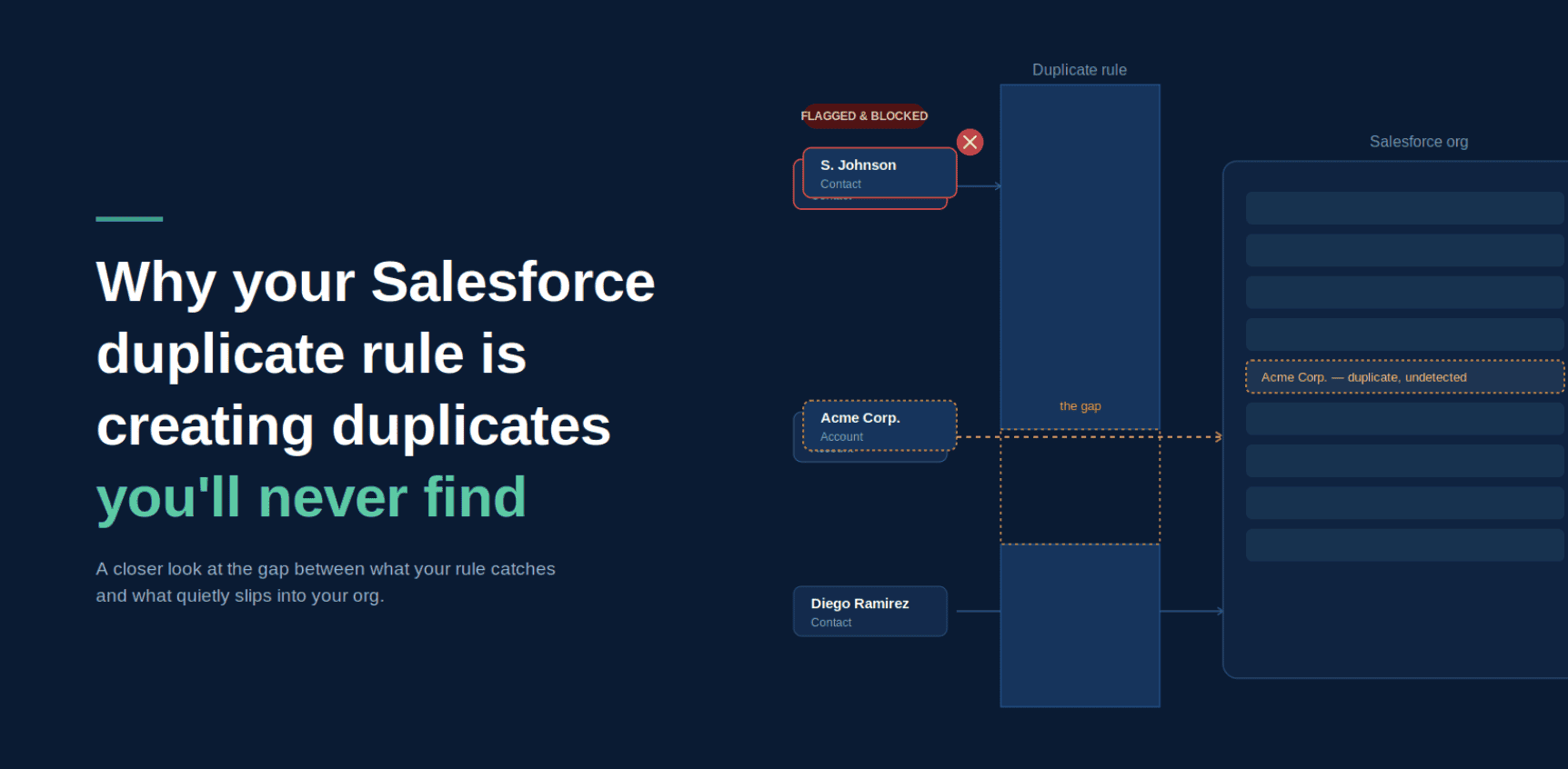
Here’s what most Salesforce duplicate rules get backwards: a blocking rule doesn’t stop bad data. It stops bad data from being detectable. The record still gets created — it just gets created in a form no future matching rule will ever recognize. This is a case for informing reps at the point of entry, not blocking them, and for treating duplicate management as a continuous process instead of a one-time gate.
The Trade Every Duplicate Rule Offers
The rule thought it prevented a duplicate. What it actually did was create one that can never be found.
That wasn’t a typo. It was deliberate, made specifically to defeat matching — which means it will defeat it every time from now on. Every dedupe run you do for the rest of that record’s life sails straight past it.
A blocking rule doesn’t stop bad data. It stops bad data from being detectable.
Detectable duplicates are fine. You merge them. It’s a Tuesday afternoon. The record that got mangled to clear your rule is the one you’ll never clean, because there’s nothing left to match on.
Why “Acme Corp” Beats a Blocked Save Every Time
Somewhere behind that rule is a belief that the CRM is a finished thing being protected from contamination.
It isn’t. Your contact data decays on its own. Titles change, people leave, companies rebrand and consolidate domains. Nobody has to touch your org for it to get worse. That’s simply the baseline reality of contact data.
So the record you blocked wasn’t threatening a clean database. It was arriving at a slowly rotting one, carrying the most current information anyone in the building had about that person.
You turned it away to protect data from 2023.
Your CRM Isn’t Finished — It’s Decaying
The org was never canon. It’s a working draft that decays when you stop writing. Defending it at the perimeter gets you the worst of both outcomes — you don’t stop the decay, and you block the one thing that offsets it.
That doesn’t mean let everything in. It means governance can’t live at the front door. If the interior is degrading continuously, the response has to be continuous too. Matching, merging, enrichment on a cycle — not a gate that fires once and leaves behind a record nobody can find.
Some reps don’t even go as far as the workaround. They stop putting the account in Salesforce at all. It lives in a spreadsheet on their desktop for eight months, until they leave and it goes with them.
Same failure. Bigger hole.
Block for Irreversibility. Inform for Correctness.
The distinction worth building around: block for irreversibility, inform for correctness.
Block when the action can’t be undone. Deleting an account with child records. Mass-reassigning ten thousand rows.
Inform when it can. Duplicates can be merged next week. Putting a gate in front of a reversible action spends real friction on something that never needed one — and hands people a reason to route around you.
The honest limit: you often can’t warn early, because you can’t detect a duplicate until enough is typed to identify one. Partly solvable — check on account name entry, on email blur, progressively — instead of waiting for save, which is the latest and most expensive possible moment to tell someone they wasted their time.
But the principle holds.
Every rule you write is a trade you’re offering someone. If the trade is bad enough, they won’t take it. They’ll find another way.
What This Looks Like Done Right
The fix isn’t looser rules — it’s moving duplicate management off the save button entirely. That’s the same problem we’re solving with Cloudingo’s continuous matching today, and it’s why we’re building a Lightning web component that lets reps flag a possible duplicate right from the record and route it to an admin, instead of forcing a decision — or a workaround — in the moment.

Meet the Author: Reid Scoggins
An experienced sales and partnerships professional, Reid specializes in helping organizations unlock the full potential of their Salesforce and Marketo investments by championing clean, streamlined data. With a background in SaaS sales and a passion for delivering ROI through data integrity, Reid empowers teams to turn data into a strategic growth asset.
Connect with Reid on LinkedIn here.