September 1, 2026
Claudeforce and Salesforce Data Quality for AI Agents: The Real Risks
On August 26, Salesforce and Anthropic announced Claudeforce. Now in September, Claude can reason over live Salesforce data and, in some cases, act on it directly — run meeting prep, review pipeline, update records, all without a rep ever opening Salesforce. That’s a genuinely useful capability jump, not just another press release. Agents doing real work through Amazon Bedrock’s trust boundary, built with regulated industries in mind — that’s worth being glad about, and we are.
But it also means the “clean up your Salesforce data someday” conversation is over. Someday is now. Up to now, AI in the CRM mostly summarized things, drafted an email you’d edit anyway, or responded to your chat. Now it will act on what it finds. And the moment a system acts on your data instead of just showing it to you, every sloppy field, every duplicate contact, every record nobody’s touched since 2023 gets a lot more expensive to leave alone.
A lot of the coverage this week reads like Claudeforce is a clean win with no downside. It isn’t, and admins deserve better than a press release dressed up as analysis. Here’s the honest list — including the risks that have nothing to do with data — and where data quality actually sits in that pile.
The biggest open question: does the economic bet even work
The most consequential risk here isn’t technical. It’s structural, and it’s Salesforce’s to lose (or win). Their own launch language describes a frontier model without Salesforce’s context as “a genius who’s never seen your deals” — the bet being that the real moat was never the interface; it was 27 years of accumulated data, workflow logic, and governance. Fine story. Nobody’s proven it yet. If the interface really does become a commodity the way this bet assumes, the pricing power slides toward whoever owns the intelligence layer — and that’s Anthropic, not Salesforce.
Not your problem to solve, but it’s worth watching play out in real time. 👀
The risk that will actually stall pilots: permissions and audit trails
Dario Amodei didn’t dance around this one on CNBC: a lot of effort went into managing permissions for Claudeforce, and the two companies are building what they’re calling “Enterprise Frontier Safeguards” for a simple reason — a tool that can change account data or update a pipeline field needs governance built into identity and approvals, not a paragraph in a policy doc nobody reads. This is the risk that shows up first in your security team’s inbox, and it’s genuinely unresolved.
The risk that’s already been filed: AI-generated content liability
This isn’t a hot take from a blog. It’s in Salesforce’s own 10-K: AI technologies may produce content that’s inaccurate, misleading, biased, or unsafe, and if a customer relies on that content and gets burned, Salesforce could face litigation, regulatory scrutiny, or a reputational mess. When a company puts a risk in its own SEC filing, that’s them telling you, in writing, that they know this could go wrong.
The friction point buyers are underestimating: token and consumption economics
Here’s the one nobody’s putting on a slide: CIOs now have a new line item sitting next to identity and permissions — token and consumption-based costs for a tool that acts, not just answers. It’s a real budgeting headache, and it stacks on top of everything else here. We’ll say it plainly, though: a data quality vendor has no business claiming it fixes your Claude bill. That’s not our lane, so we’re not going to pretend it is.
Where data quality actually fits — a prerequisite, not the headline
So is data quality the biggest risk on this list? No. It doesn’t even crack the top two. What it actually is: one piece of the governance conversation. At least one analyst covering the CIO decision put it plainly — sequence your agent rollout by how messy the data is. Start where it’s cleanest (internal summarization, guided next steps), and only let agents touch outbound actions and record updates once the governance work underneath it is actually done.
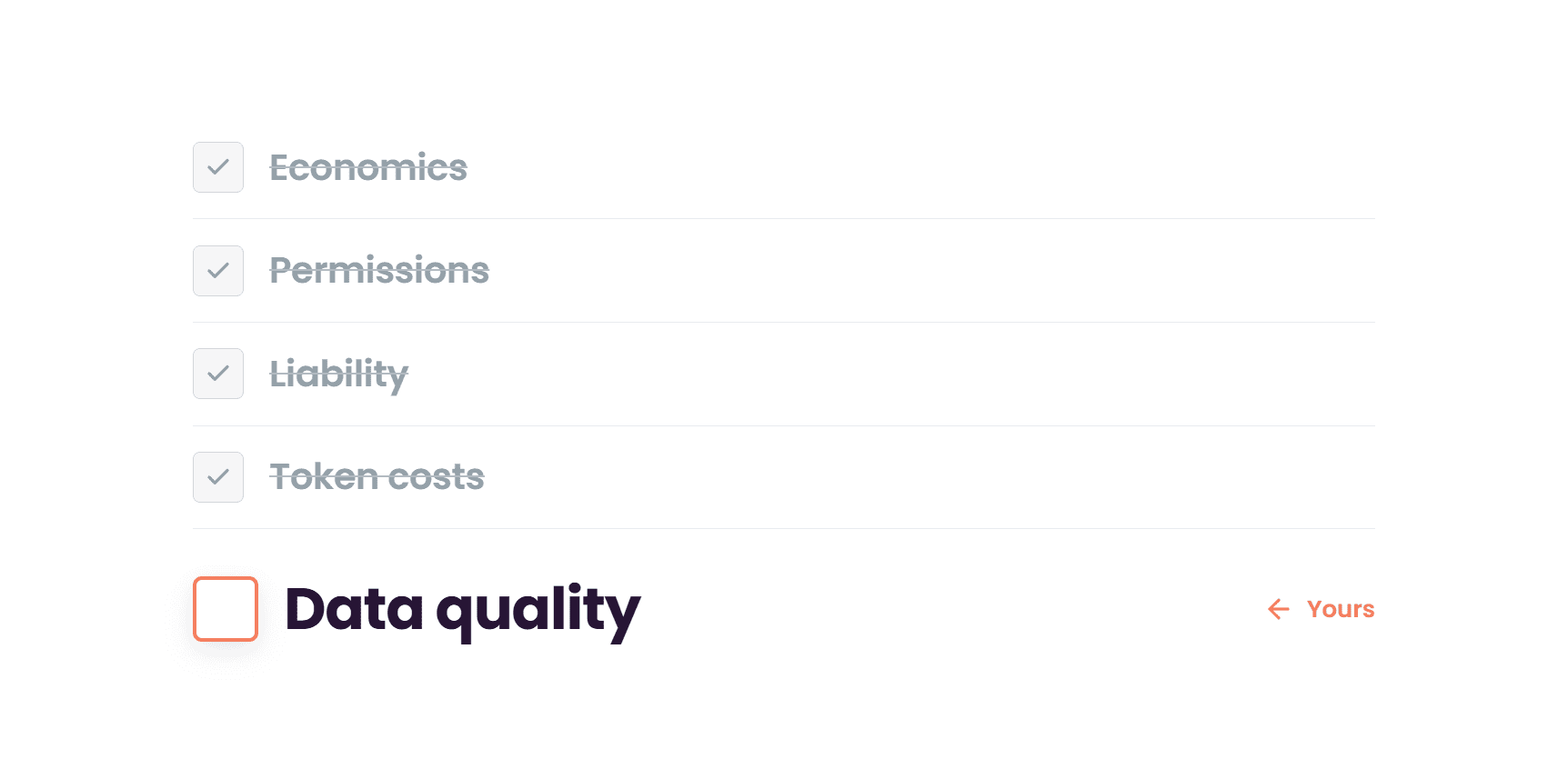
That’s a more useful take than “AI is coming, go clean your data,” and here’s why it matters: of the four risks above, the economics, the permissions, the liability, the token bill — none of them are yours to fix. Salesforce, Anthropic, your finance team, your security team, they own those.
Data quality is the one item on this entire list an admin can start on this afternoon, with no meeting, no vendor waiting period, no roadmap dependency.
What Salesforce data quality for AI agents actually means
Not a scramble before a launch date. Ongoing groundwork that has to hold up under whatever permission model Salesforce and Anthropic eventually land on:
- Duplicate records found and merged — so an agent isn’t stuck guessing which of three “same” contacts is the real one
- Standardized fields — so automation and agent parsing don’t choke on inconsistent formatting
- Prevention at the point of entry — so the mess doesn’t grow back the week after cleanup
- Stale and dead records handled on purpose — not left sitting there for an agent to act on by default
How Cloudingo fits
We’re not going to tell you Cloudingo fixes Claudeforce’s permission model, its economics, or its liability exposure. Those aren’t data problems, and pretending otherwise would be exactly the kind of overclaiming we just spent this whole post calling out in other people’s coverage.
What Cloudingo actually does is the piece that’s in your control: no-code deduplication, merging, standardization, and prevention that makes Salesforce data trustworthy enough to hand to an agent in the first place. That’s the groundwork, and it’s worth doing no matter how the rest of this shakes out.