July 13, 2026
What Agentforce Actually Requires From Your Salesforce Data
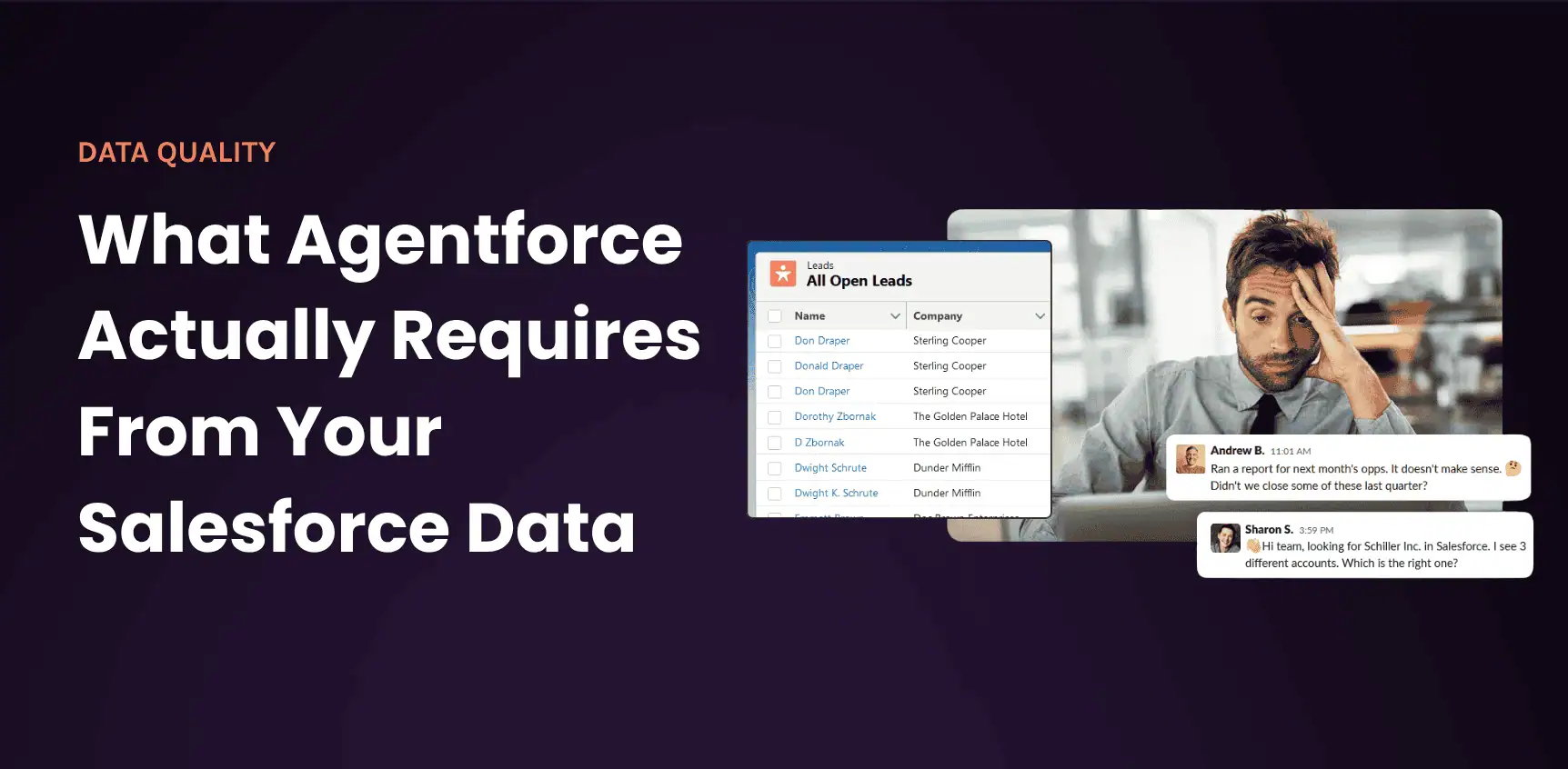
Salesforce data quality used to be an admin chore — something you got to when reports looked off or a merger dumped 40,000 duplicate leads into your org. In 2026, that’s no longer true. Salesforce has restructured its own platform around the assumption that your data is clean, and AI agents are now taking autonomous action on whatever data actually sits in your org… clean or not. A dedicated, ongoing approach to data quality has moved from “nice to have” to required infrastructure.
Salesforce already made this call for you
You don’t have to take a vendor’s word for why data quality suddenly matters more. Salesforce told you directly.
The company rebranded Data Cloud as Data 360 and positioned it as the mandatory data layer underneath Agentforce — the explicit message being that agents can’t reason, act, or be trusted without a unified, governed data foundation underneath them. That’s not a feature announcement. It’s an admission that agentic AI doesn’t work on top of messy CRM data.
Salesforce backed that up in its own certification requirements. The 2026 update to the Certified Administrator exam made Data & Analytics the most heavily weighted section at 17% — ahead of configuration and setup, which used to be the core of the job. Salesforce is formally telling admins that managing data quality is now central to the role, not a side responsibility.
And the market is bearing this out the hard way. Multiple 2026 analyses of Agentforce adoption report that fewer than 10% of Salesforce customers have scaled an agent past a pilot, with full enterprise rollouts commonly taking five to eleven months. The agent-building part is rarely the holdup. Getting the underlying org data ready is.
What changes when AI agents can act on your data
With a dashboard or a report, bad data produces a bad number — something a human eventually notices and questions. With an autonomous agent, bad data produces a bad action that has already happened by the time anyone looks.
Think about what that means concretely:
- An agent updating opportunity stages or contact records based on a duplicate that has stale or conflicting field values
- An agent routing a lead based on ownership data that’s split across two versions of the same account
- An agent triggering a service or sales playbook off a record that’s missing the fields it needs to reason correctly
- A forecast or scoring model trained on a CRM where the same customer exists as three different records with three different histories
None of these are hypothetical edge cases — they’re the direct, predictable result of duplicate, incomplete, or inconsistent records sitting in a system that’s now empowered to act without a human double-checking first. The risk profile of bad data didn’t just go up incrementally. It changed category, from “annoying” to “actively costly.”
Why this is now an ongoing operational problem, not a cleanup project
It’s worth being precise about why this can’t be solved with a one-time cleanup sprint.
Salesforce’s built-in tools are genuinely useful for flagging new duplicates as they’re entered. But resolving an existing backlog of duplicate, stale, or inconsistent records at scale — and keeping data validated, standardized, and current on an ongoing basis as your org keeps growing — is a different, continuous operational problem. It’s not that native functionality is broken; it’s that it was built to catch a subset of new-record issues, not to run the kind of standing data quality discipline that AI-driven automation now requires. (If you want the detailed, field-by-field breakdown of where native tools stop, we’ve laid that out separately.)
That’s the real shift: data quality has to become a maintained system, not a project you run once and check off. The orgs that get value from Agentforce in 2026 aren’t the ones with the flashiest agent use cases — they’re the ones that treated their data foundation as infrastructure that gets monitored and maintained continuously, the same way they’d treat system uptime or security.
What “AI-ready” Salesforce data actually means
“AI-ready” gets thrown around a lot without being defined. In concrete, checkable terms, it means:
- Deduplicated — no split histories across multiple records for the same person or account
- Standardized — consistent formatting on the fields automation and agents actually key off (names, addresses, phone numbers, picklists)
- Complete — required fields populated, not left blank in ways that break an agent’s reasoning
- Validated — addresses and contact data that are actually correct, not just present
- Current — stale or dead records identified and removed rather than left to accumulate
None of this requires exotic tooling. It requires an ongoing process — merging duplicates continuously (not annually), preventing new ones at the point of import, validating data as it enters or changes, and giving admins visibility into org health without hand-auditing individual records.
The business case, stated plainly
If your organization is investing in Agentforce, Data 360, or any AI-driven Salesforce initiative in the next twelve months, the data foundation work isn’t a parallel track — it’s the prerequisite. Every implementation partner publishing 2026 guidance is converging on the same point: audit and fix data foundations before adding more AI capability on top, not after.
That’s the case for treating data quality as strategic infrastructure rather than a maintenance task someone gets to eventually. The teams that get this right now won’t be the ones who “did an AI pilot.” They’ll be the ones whose CRM data was trustworthy enough for an agent to act on safely in the first place.
FAQ
Yes. Salesforce has explicitly tied Agentforce reliability to the quality of the data underneath it via Data 360, and industry reporting on Agentforce rollouts consistently points to data readiness — not agent configuration — as the main blocker to scaling past a pilot.
What’s the difference between Salesforce’s native duplicate rules and a dedicated data quality tool?
Native rules are built to flag potential duplicates as new records are entered. Resolving an existing backlog at scale, and maintaining ongoing standardization and validation, is a separate, continuous operational need. See our full comparison of Cloudingo and Salesforce’s native tools for the detailed breakdown.
Deduplicated records, standardized formatting on key fields, complete required fields, validated contact and address data, and stale records removed or flagged — maintained on an ongoing basis rather than cleaned up once.
Pricing varies by platform and is generally billed per Salesforce org rather than per user. See current pricing.