April 30, 2026
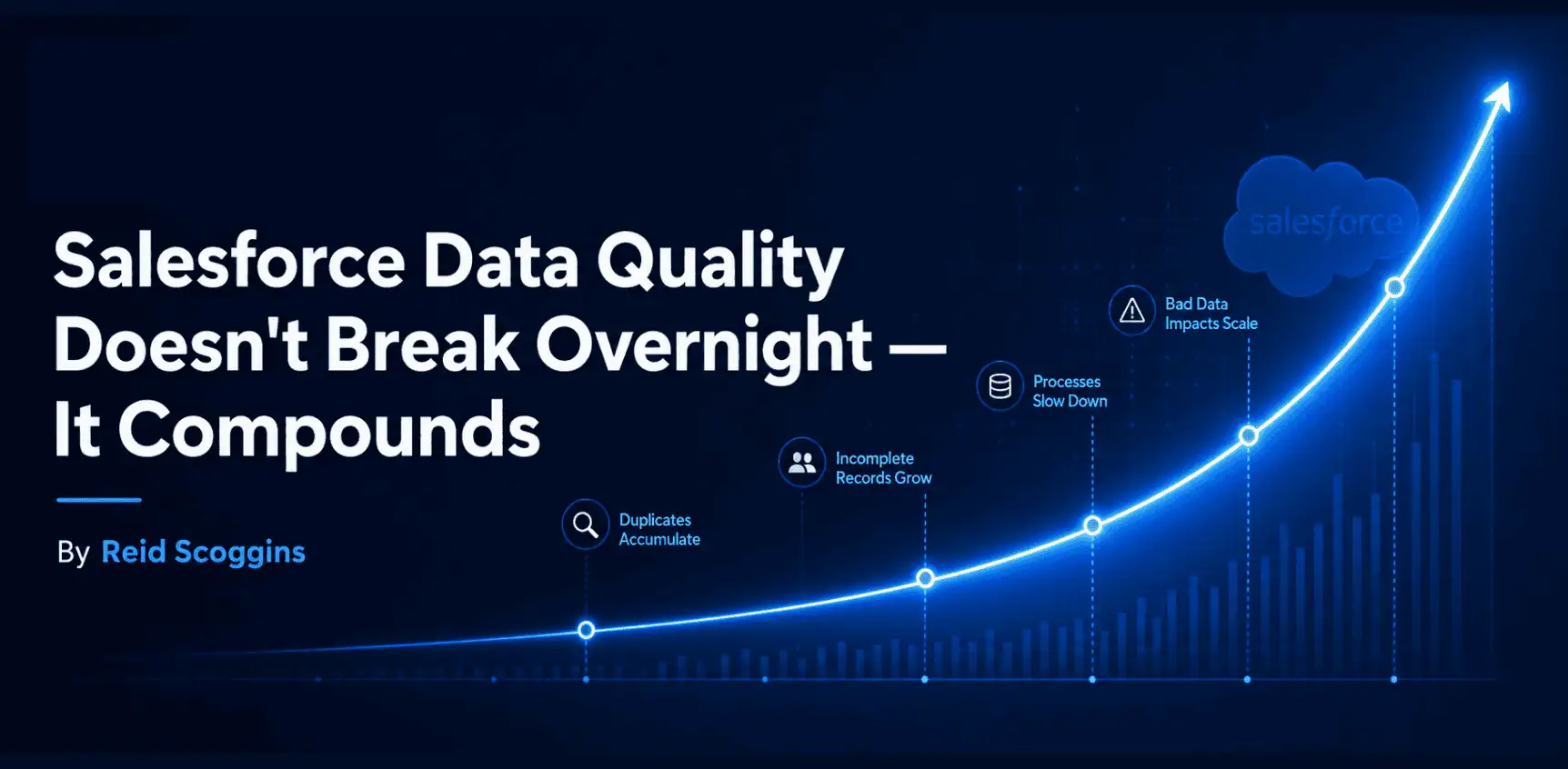
Salesforce Data Quality Doesn’t Break Overnight — It Compounds
The Salesforce orgs that age well aren’t built in a single sprint. They’re built in the margins — one steady decision at a time.
When GM partnered with Toyota to reopen a shuttered California plant in 1984, they expected to import a manufacturing miracle. Toyota’s production system was legendary. The playbook was available. The workforce was the same UAW labor that had built American cars for decades.
The results still lagged.
Not because the system was wrong, but because you can’t replicate an outcome without inheriting and understanding the foundation behind it. Toyota’s advantage wasn’t the process document. It was the years of compounding decisions that gave that process its teeth — small corrections, consistent standards, and the discipline to maintain what works instead of constantly chasing what’s new.
Your Salesforce org operates the same way.
Durable orgs aren’t built in big launches. They’re built in the margins — in the field governance decision that doesn’t make it into the release notes, the deduplication standard that holds even when no one’s watching, the workflow that stays simple enough that the next admin can actually understand it. None of those choices feel significant in the moment. All of them are directional.
Why Overengineering Is the Real Threat to Salesforce Org Health
The thing that kills a Salesforce org usually isn’t neglect. It’s overengineering.
Most teams fear the obvious threats — the duplicate that slips in, the missing required field, the import that went sideways. Those are recoverable. The real threat to long-term Salesforce data quality is invisible: the automation that made sense at the time but that nobody wants to touch now, the logic so deeply nested it’s become institutional mythology, the CRM data that’s quietly eroded until your reps stop trusting what’s in the platform.
Complexity calcifies. And a calcified Salesforce org doesn’t collapse dramatically — it just becomes increasingly expensive to operate and increasingly resistant to the change your business actually needs.
Cadence Over Cleanup: The Foundation of a Trustworthy CRM
Durability isn’t about achieving perfection at any single moment. It’s about maintaining the capacity to absorb change without losing coherence. And that requires a cadence — not a one-off cleanup.
The difference matters. A single cleanup is reactive. You notice something is wrong in your Salesforce org, you fix it, you move on. A cadence is structural. You build visibility into the platform so the small things surface before they compound into expensive data quality problems.
This is the difference between orgs that stay trustworthy and orgs that require heroic recovery efforts every eighteen months.
What Cloudingo Intelligence Monitors — and Why It Matters for Salesforce Admins
This is where Cloudingo Intelligence earns its place. Not as a one-time diagnostic, but as the monitoring layer that runs beneath everything else — watching changes that nobody announced, but everyone will eventually feel.
The moments that actually damage a Salesforce org rarely announce themselves. Set your alerts. Build the habit. Here’s what to watch:
API consumption. You’ve quietly burned through 50% of your Salesforce API allotment. No error. No warning. Just a sync that’s going to die at the worst possible time.
Field deletion. Someone removed a field your marketing automation platform was using for segmentation. Your nurture flow is now writing to nothing. The campaign keeps running.
Anomalous access. A login from outside the norm. Could be a traveling rep. Could be something worse. Either way, you want to know before it becomes a legal conversation.
None of these show up in a quarterly review. They show up in the moment, and the real question is whether you hear about it from a Cloudingo alert or from a frustrated VP asking why the numbers don’t add up.
The Long Game: Compounding Decisions in Salesforce Data Quality
The long game rewards organizations willing to treat their Salesforce foundation as something worth maintaining — not just something to build on top of.
Compounding works in Salesforce data quality the same way it works in manufacturing, finance, and fitness. The advantage isn’t the single right move. It’s the accumulation of steady ones — and the visibility to know when something’s drifting before it’s too late to course correct.
AI-readiness, Agentforce deployment, and autonomous workflows all depend on one thing: a Salesforce org someone actually trusts. That’s not built in a sprint. It’s maintained over time.

Meet the Author: Reid Scoggins
An experienced sales and partnerships professional, Reid specializes in helping organizations unlock the full potential of their Salesforce and Marketo investments by championing clean, streamlined data. With a background in SaaS sales and a passion for delivering ROI through data integrity, Reid empowers teams to turn data into a strategic growth asset.
Connect with Reid on LinkedIn here.