January 13, 2026
Clean Salesforce Data for AI: Why Agentic AI Depends on Automation
The promise of agentic AI in Salesforce — and why it often falls short
Agentic AI is quickly becoming one of the most talked about advancements in the Salesforce ecosystem. The vision is compelling: AI agents that don’t just surface insights, but actively research accounts, qualify leads, route work, and take action across sales, marketing, and service.
For many Salesforce Admins and Ops leaders, the reality looks different.
When AI agents operate on outdated, duplicated, or incomplete records, they don’t just make small mistakes. They scale those mistakes across workflows, teams, and customers. What was once a reporting issue becomes an operational risk.
Salesforce has been consistent on this point. AI effectiveness depends on data readiness. Without clean, trusted data, agentic AI doesn’t accelerate work—it amplifies data debt.
Why AI fails without clean, trusted data (Salesforce’s perspective)
AI systems are only as reliable as the data they consume. In Salesforce, that data includes accounts, contacts, leads, activities, and the relationships between them.
According to Salesforce’s blog, How to Clean Your Data for AI Agents Without Breaking the Bank, poor data quality creates downstream consequences well beyond messy reports. When AI is involved, those consequences multiply. Duplicate records, missing fields, and conflicting values confuse AI logic and reduce trust in its outputs.
Salesforce frequently reinforces a simple reality: AI cannot fix bad data yet. It can only act on it.
If an AI agent sees three versions of the same contact with different ownership, lifecycle stage, or engagement history, it cannot reliably decide what action to take. At scale, this leads to misrouted leads, inaccurate forecasts, and automation that feels unpredictable rather than helpful.
What Salesforce actually means by “data readiness”
One common mistake teams make is assuming data readiness means “clean everything.”
Salesforce argues otherwise.
In its How to Measure Your Data Readiness guide, Salesforce positions readiness as a measurable state tied directly to how data is used—not how much data exists. Data readiness focuses on whether your data is fit for automation, analytics, and AI-driven decision-making.
Key points include:
- Accuracy: Is the data correct and verified?
- Completeness: Are critical AI-driving fields populated?
- Consistency: Is data standardized across objects and sources?
- Uniqueness: Are duplicates controlled so AI can identify a single source of truth?
- Timeliness: Is data refreshed often enough to support real-time decisions?
This is especially important for agentic AI. Agents act continuously. If data quality degrades, AI outputs degrade just as fast.
That’s why Salesforce recommends measuring data readiness before deploying AI or advanced automation. Without a baseline, teams are guessing.
Why manual data cleanup doesn’t scale
Most Salesforce teams start with good intentions. They run reports, export spreadsheets, merge duplicates, and host the occasional “data cleanup day.”
Salesforce acknowledges this approach—but also its limits.
According to the blog above, Salesforce notes that manual cleanup is expensive, reactive, and short-lived. Data begins to decay the moment cleanup stops. In modern Salesforce orgs with multiple integrations, APIs, and inbound sources, manual hygiene simply can’t keep up.
For agentic AI, this creates a serious problem. AI agents don’t wait for quarterly cleanups. They act on whatever data exists in the moment.
How automation sustains AI-ready Salesforce data
If clean data is the fuel for agentic AI, automation is what keeps that fuel usable over time.
Salesforce consistently points to automation as the mechanism that maintains data quality at scale. Rather than relying on people to fix problems after the fact, automation helps prevent issues from entering the system in the first place.
Automation supports AI readiness by:
- Enforcing required fields for AI-critical workflows
- Standardizing data as it enters Salesforce from multiple sources
- Identifying and resolving duplicates before they impact downstream processes
- Continuously monitoring data health instead of relying on audits.
This shift is foundational. Agentic AI depends on consistency. Automation is the only scalable way to deliver it.
What teams should focus on first (practical guidance)
Salesforce guidance makes one thing clear: you don’t need to clean everything. You need to clean what your AI and automation actually use.
A practical starting point looks like this:
Focus on AI-critical data first
Identify the objects and fields driving forecasting, routing, personalization, and lifecycle automation. For most teams, this includes Accounts, Contacts, Leads, and Opportunities.
Measure before you fix
According to Salesforce’s data readiness guidance, teams should assess duplication, completeness, and accuracy before making changes. Measurement creates clarity and prevents wasted effort.
Automate the highest-risk entry points
Look for where bad data creates downstream impact—form submissions, integrations, imports, and handoffs between systems.
Treat data quality as an ongoing operation
AI readiness isn’t a one-time project. It’s an operational discipline supported by automation, monitoring, and continuous improvement.
Closing takeaway and next step
Agentic AI in Salesforce only works when it’s fueled by clean, trusted data—and automation is the only scalable way to maintain that foundation.
Salesforce’s own guidance reinforces this reality. Teams that succeed with AI prioritize data readiness, focus on the data that matters most, and rely on automation to keep that data reliable over time.
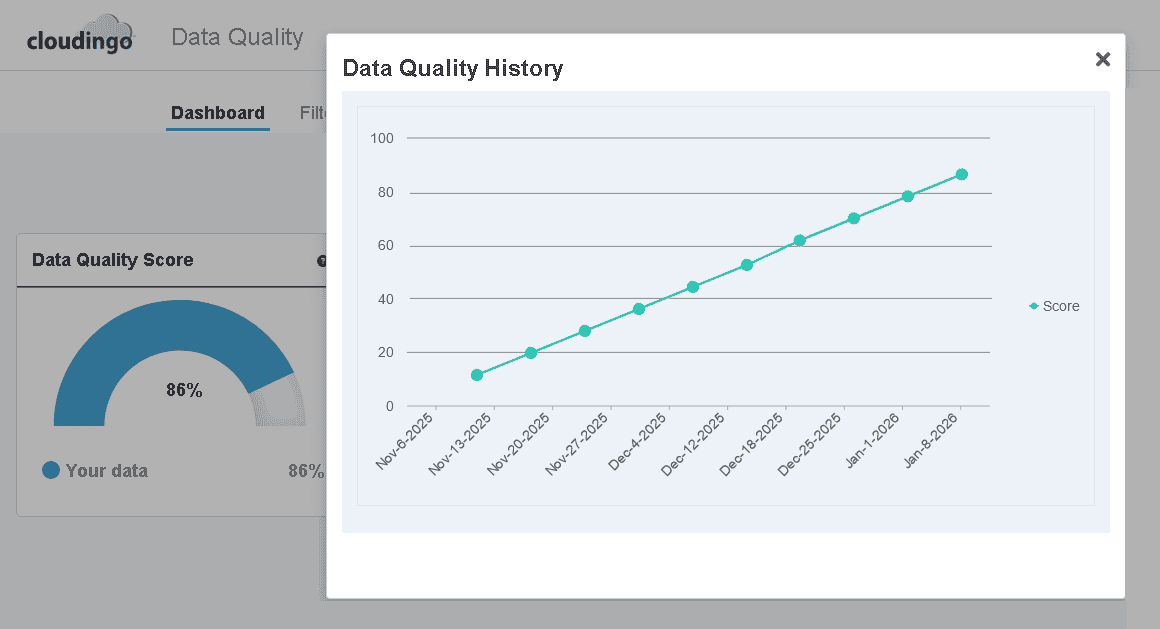
Before investing in AI agents or advanced automation, it helps to understand where your Salesforce data stands today. A data quality score gives teams a clear baseline—highlighting duplicates, gaps, and risk areas—so you can prioritize cleanup and automation efforts with confidence.
For many teams, that baseline is the smartest first step toward AI that actually delivers value.
Here is an example of Cloudingo’s data quality score tracking: